Quick Summary
Red light therapy stimulates cellular energy and circulation while reducing inflammation, making it a proven, supportive tool for tooth sensitivity, bleeding gums, and surgical healing. However, consumer devices like light toothbrushes deliver lower, inconsistent doses compared to clinical tools, and they cannot remove plaque, kill odor-causing bacteria, or replace professional care. Used properly, at-home red light is a helpful daily add-on—not a cure or substitute for diagnosing and treating the root cause of gum disease.
Most people buying a red light toothbrush are asking the wrong question. They want to know whether red light works. The better question is whether the device in their hand delivers enough light, to the right place, for long enough, to do what the research shows.
I made that point recently to The Daily Beast, which tested a red light toothbrush for six weeks and asked me to weigh in on the science. You can read the full Daily Beast review here. It is a fair, well-reported piece, and it gets at the heart of a trend I see every week in my Manhattan practice: patients arriving with LED gadgets and real questions about whether they are helping.
Here is what I told the reporter, what I have written for dental professionals in Perio-Implant Advisory, and what it means for four problems my patients ask about most: tooth sensitivity, bleeding gums, bad breath, and healing after gum surgery.
What Red Light Actually Does in Your Mouth
Red light therapy, known clinically as photobiomodulation (PBM), uses visible red light (roughly 630–670 nm) and near-infrared light (roughly 800–900 nm). It does not heat or burn tissue. Instead, the light is absorbed inside your cells' mitochondria, where it stimulates an enzyme called cytochrome c oxidase. The result is more cellular energy (ATP), the release of nitric oxide to improve local circulation, and a measurable drop in inflammatory signaling.
As I told The Daily Beast, “the underlying science of photobiomodulation reducing inflammatory markers, supporting circulation via nitric oxide release, and accelerating oral wound healing is real and reasonably well-established in the dental literature.”
As both a periodontist and a naturopathic doctor, this is the part I find most compelling. Gum disease is not just a mouth problem. Chronic gum inflammation is associated with cardiovascular disease, poorer blood sugar control in diabetes, and cognitive decline. Any safe tool that lowers the inflammatory burden in the mouth deserves attention, as long as we are honest about what it can and cannot do.
Why the Device Matters More Than the Light
Here is the uncomfortable part. Most of the studies behind red light in dentistry used handheld light wands or intraoral LED devices that hold a steady, measured dose on one spot in a clinical setting. A toothbrush is a different animal. It moves constantly, and foam, toothpaste, and saliva scatter and block light before it reaches the gums.
Dose is measured in joules per square centimeter (J/cm²). In my own review of the literature, I put the typical therapeutic dose for gum inflammation at about 5 J/cm² per site, drawn from more than 100 published studies, roughly 75% of which show a positive effect. The toothbrush The Daily Beast tested lists about 1.2 J/cm², and the manufacturer itself acknowledges that the real number shifts with brushing motion, angle, and contact time.
That does not mean a red light toothbrush is useless. It means you should treat it as a low-dose daily add-on, not as a treatment.
Red Light for Tooth Sensitivity
Evidence level: strongest of the four. If cold water or a cup of coffee makes you wince, the most likely cause is exposed dentin, often from gum recession, clenching, or acid wear. Multiple randomized controlled trials show that red and near-infrared light reduces sensitivity pain scores, with reported reductions of roughly 40% to 70% after repeated applications. The studies used about 20 to 30 seconds of focused light per tooth, at low doses.
Two cautions. First, light treats the symptom, not the cause. If you grind your teeth or your gums are receding, that needs to be diagnosed and managed, often with a night guard or gum grafting. Second, desensitizing toothpastes containing potassium nitrate or hydroxyapatite are still first-line care. Red light works best layered on top of them.
Red Light for Bleeding Gums
Evidence level: promising, as an add-on. Bleeding when you brush or floss is the earliest visible sign of gum inflammation. The Daily Beast review cites a randomized trial of an electric toothbrush with built-in LEDs: at three weeks there was no difference from a regular brush, but at six weeks the LED group had significantly less bleeding. The reporter noticed the same thing in her own mouth at about five weeks.
That timeline matters. If you try one of these devices, give it at least six weeks of consistent use before judging it.
The stronger evidence is in the office. In several trials where one side of the mouth received a deep cleaning (scaling and root planing) plus light therapy and the other side received the deep cleaning alone, the light-treated side healed with better clinical results. That is how I think about red light for gum disease: it amplifies proper treatment rather than replacing it.
Bleeding gums are a symptom, not a diagnosis. Red light does not remove plaque or tartar, and it does not replace a professional cleaning. If your gums bleed, the first step is a periodontal evaluation to find out whether you have gingivitis, which is reversible, or periodontitis, which involves bone loss and needs treatment. A gadget that quiets the bleeding without addressing the cause can hide a problem that keeps progressing.
Red Light for Healing After Gum Surgery
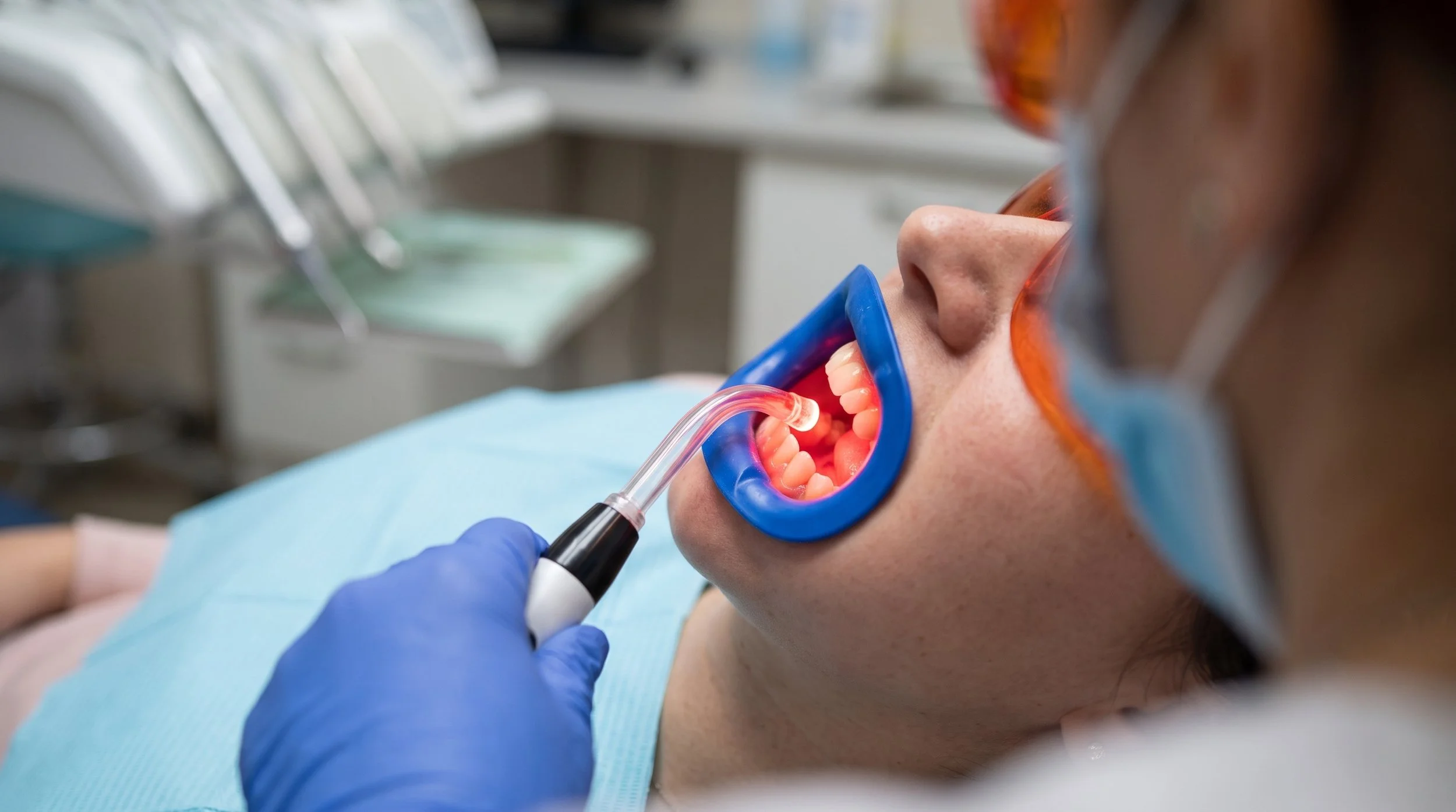
Evidence level: encouraging, and part of my own surgical protocol. Wounds in the mouth heal under hard conditions: constant saliva, bacteria, and the forces of chewing and speaking. Studies of red light after extractions and oral surgery show faster closure of the surface tissue and less pain after the procedure, using low doses of about 1 to 3 J/cm² per site.
In my office, we use a red light panel before and after surgical procedures to support healing. Because it is applied in the office, the dose is controlled, which is exactly the problem a toothbrush cannot solve. The research volume here is still smaller than for sensitivity, so I present it to patients as a supportive measure that may make recovery more comfortable, not as a guarantee of faster results.
If you are recovering from gum surgery, do not use any home device on the surgical site unless your surgeon has approved it. A vibrating brush head on fresh sutures can do more harm than the light does good.
Red Light and Bad Breath: Where the Claims Get Ahead of the Evidence
Evidence level: indirect for red light alone. This is where I want to be most precise, because I treat halitosis every day. Plain red light, on its own, has not been shown to cure bad breath.
Bad breath that starts in the mouth is mostly caused by bacteria living deep in the coating on the back of the tongue and in gum pockets. These bacteria produce volatile sulfur compounds, the gases that create the odor. The light-based treatments with real evidence for halitosis are different technologies:
Antimicrobial photodynamic therapy (aPDT): light combined with a photosensitizing agent that, once activated, kills the bacteria. The light alone is not doing the work.
Laser tongue debridement: an in-office laser that removes the bacterial coating on the tongue. Studies show sulfur-gas reductions lasting about three months, well beyond what tongue scraping achieves. I have written about this in detail for dental professionals.
Where red light can help is indirectly. Inflamed, bleeding gum pockets feed the bacteria that produce odor. Calming that inflammation removes some of their food supply. So red light may support a halitosis plan, but it is not the plan. Persistent bad breath also often has a gut or sinus component, which is why I evaluate both the mouth and the digestive system before recommending treatment.
How to Use an At-Home Red Light Device Wisely
Check the specs. A reputable device lists its wavelengths and its irradiance in mW/cm². If it does not, you cannot know the dose.
Expect weeks, not days. Benefits in the research appear with consistent use over about six weeks.
Keep the basics. Flossing, professional cleanings, and treating the cause of sensitivity still do the heavy lifting.
Protect your eyes. Never look directly into the LEDs.
Do not let it mask symptoms. Bleeding, recession, or loose teeth need a diagnosis, not just a device.
Frequently Asked Questions
-
They may help modestly, mainly for gum bleeding after about six weeks of use. They deliver a lower and less consistent dose than the devices used in most research, so think of them as a daily supplement to good care, not a treatment.
-
At the low doses used in oral care, red and near-infrared light is considered low-risk. Avoid direct eye exposure, and leave high-powered protocols to a dental professional.
-
No. Red light does not remove plaque, tartar, or infection below the gumline, and it cannot regrow lost bone. It can support treatment by reducing inflammation, but periodontitis requires professional periodontal therapy.
-
Not on its own. Effective light-based halitosis treatments use photodynamic therapy or in-office laser tongue debridement. Red light may help indirectly by calming gum inflammation.
-
In-office red light can support healing and comfort after surgery. Do not use a home device on a surgical site without your periodontist's approval.
Red light therapy is one of the more promising tools in modern oral care, and the biology behind it is sound. But the benefit depends on the dose, and the dose depends on the device. Used wisely, alongside proper diagnosis and treatment, it can help with sensitivity, bleeding gums, and healing. Used as a substitute for care, it can give you a false sense of security while gum disease, with all its connections to the rest of your body, keeps progressing.
If you are curious whether red light therapy fits your situation, or you want to know why your gums bleed, your teeth are sensitive, or your breath will not stay fresh, start with an evaluation.
