
Bleeding Around a Dental Implant? What NYC Patients Should Do Next
Key Takeaways
✓ Occasional bleeding after aggressive brushing can happen, but bleeding that keeps coming back is not normal. Recurring bleeding around a dental implant is an early sign that the gum tissue or bone supporting it may be inflamed or infected.
✓ Pain is often not the first symptom. Implants lack the ligament and nerve feedback of natural teeth, so inflammation can progress quietly. Swelling, pus, a bad taste, recession, or a loose crown may appear well before the implant feels unstable.
✓ There is an important difference between peri-implant mucositis (inflammation limited to the soft tissue) and peri-implantitis (inflammation with bone loss). Caught at the earlier stage, the problem is generally more manageable.
✓ Bleeding is not always an infection. Trapped cement, a loose crown or abutment, excess bite force, recession exposing implant threads, or a restoration that is hard to clean can all cause it, and each calls for different treatment.
✓ Do not try to fix it at home. Keep the area clean with gentle technique, but never tighten a screw, remove a crown, or drain swelling yourself. Many dental implant complications are treatable when they are evaluated early, and ongoing periodontal maintenance is what keeps a treated implant stable.
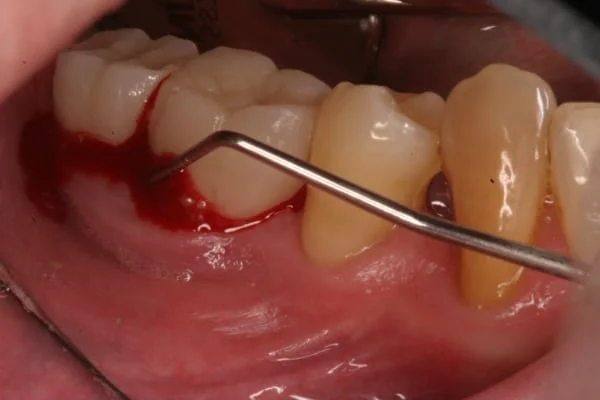
Example Patient With Bleeding Around a Gum
Bleeding around a dental implant is not something to brush off, especially if it happens more than once or comes with swelling, tenderness, a bad taste, pus, gum recession, or a loose crown. A small amount of bleeding may happen if you accidentally scrape the gum tissue while cleaning, but recurring bleeding near an implant can be an early warning sign that the tissue supporting the implant is inflamed or infected.
For NYC patients, the most important step is not to wait for pain. Dental implant problems can develop even when discomfort is mild. In some cases, pain is not the first symptom. Bleeding, redness, swelling, drainage, or a change in how the implant feels may appear before the implant becomes unstable. A periodontist can evaluate the gum tissue, check the bone around the implant, and determine whether the implant can still be protected.
At Dr. Scott Froum’s Midtown Manhattan periodontal practice, patients are evaluated for dental implant complications with a focus on early diagnosis, gum and bone support, and preserving implant function whenever possible.
What Bleeding Around an Implant Can Mean
A dental implant is held in place by bone and protected by gum tissue. When bacteria collect around the implant, the surrounding tissue can become inflamed. Peri-implant mucositis is inflammation limited to the soft tissue around an implant, without bone loss. When inflammation progresses and the bone supporting the implant starts to deteriorate, the condition is known as peri-implantitis. Periodontists also grade peri-implantitis as early, moderate, or advanced based on probing depth and how much of the implant's supporting bone has been lost, following a widely cited classification proposed by Froum and Rosen in 2012.
This distinction matters because early inflammation may be easier to treat than advanced bone loss. If bleeding is caused by inflammation around the implant, prompt care may help keep the problem from progressing. If bone loss has already started, treatment may need to be more involved and should be planned by a clinician who regularly treats implant complications.
Bleeding may also be related to other issues, including trapped cement, a loose implant crown or abutment, excess bite pressure, gum recession that exposes implant threads, or difficulty cleaning around the restoration. The right treatment depends on the cause, which is why a focused periodontal evaluation is important.
Symptoms That Should Be Checked Promptly
Bleeding is only one sign of a possible implant problem. You should schedule an evaluation if you notice red or tender gum tissue around the implant, swelling, pus, a bad taste, persistent bad breath, gum recession, exposed metal threads, pain when chewing, a crown that feels loose, or movement in the implant itself.
Some patients assume that an implant is healthy because it does not hurt. That is not always reliable. Implants do not have the same ligament and nerve response as natural teeth, so inflammation can progress quietly. By the time an implant feels loose, more support may already be affected.
If bleeding happens once after aggressive flossing, monitor the area and clean gently. If it happens repeatedly, or if the gum looks puffy or bleeds every time you brush, it is time to call a periodontist. Repeated bleeding around an implant is a clinical sign that should be taken seriously.
What To Do Today If Your Implant Is Bleeding
Start by keeping the area clean, but do not dig under the gumline or use sharp objects around the implant. Brush gently with a soft toothbrush and continue the home-care routine recommended by your dental team. If you use a water flosser, keep the pressure comfortable rather than forceful. Avoid smoking, since it can interfere with healing and increase the risk of implant-related inflammation.
Do not try to remove a loose crown, tighten a screw, drain swelling, or treat pus at home. These problems need professional evaluation. Do not ignore the issue because you have a busy schedule or because the implant still functions. In Manhattan, patients often delay care because they are managing work, travel, and family obligations, but implant infections can become more complex when they are left untreated.
The next practical step is to schedule an exam with a periodontist experienced in implant complications. Bring any recent dental X-rays if you have them, and be ready to share when the implant was placed, who restored it, whether you have had gum disease, whether you smoke, and whether you have diabetes or other medical conditions that can affect healing.
How a Periodontist Evaluates Bleeding Around an Implant
A periodontal implant evaluation usually begins with a review of your symptoms and dental history. The gum tissue around the implant is checked for bleeding, swelling, pocket depth, recession, and drainage. X-rays or 3D imaging may be recommended to evaluate the level and shape of the bone around the implant. The restoration may also be checked to see whether the crown, abutment, or screw is loose or creating areas that are difficult to clean.
Dr. Froum’s office uses advanced technology, including 3D imaging when appropriate, to help understand the relationship between the implant, bone, gum tissue, and surrounding anatomy. This is especially helpful when deciding whether an implant can be treated, repaired, regenerated, or, in more advanced cases, removed and replaced after grafting.
The goal is not simply to stop the bleeding for a few days. The goal is to identify why the bleeding is happening and protect the long-term stability of the implant.
Can a Bleeding or Infected Dental Implant Be Saved?
Many dental implant complications are treatable when they are diagnosed early. Treatment may include professional decontamination of the implant surface, modification of the crown or restoration, treatment of inflamed gum tissue, laser-assisted therapy in selected cases, bone grafting, gum grafting, or a combination of approaches. If the implant fixture is still stable and enough bone remains, the treatment plan may focus on controlling infection and regenerating lost support.
If the implant is loose, fractured, or has severe bone loss, saving it may not be predictable. In that situation, the safest option may be removal, site repair, grafting, and planning for a future replacement. Even then, identifying the cause of failure is important so the next implant has a better chance of long-term success.
This is one reason to seek care early. The sooner a problem is evaluated, the more options may be available.
Why Maintenance Matters After Implant Treatment
Dental implants require professional maintenance, just like natural teeth require regular periodontal care. The AO/AAP consensus resource on peri-implant diseases and conditions highlights the importance of prevention and management strategies because peri-implant disease can affect both soft and hard tissues. Patients with a history of gum disease, smoking, diabetes, heavy plaque buildup, previous implant problems, or complex restorations may need maintenance visits more often than twice a year.
At a periodontal maintenance visit, the implant area can be cleaned with instruments designed for implant surfaces, the gum tissue can be monitored for bleeding or pocket changes, and X-rays can be taken when needed. These visits are also a chance to review home care, flossing aids, water flossing technique, nightguard use, and bite changes that could affect the implant.
For many patients in Midtown East, Turtle Bay, Sutton Place, Roosevelt Island, and surrounding NYC neighborhoods, consistent maintenance is one of the simplest ways to protect the investment they have already made in implant treatment.
When To Call a Midtown Manhattan Periodontist
Call for an evaluation if bleeding around an implant lasts more than a few days, returns repeatedly, or appears with swelling, pus, gum recession, tenderness, looseness, or a bad taste. Call sooner if the implant feels mobile, if you cannot chew comfortably, or if the crown feels like it is moving.
Dr. Scott Froum provides treatment for dental implant complications in Midtown Manhattan and helps patients determine whether an implant can be saved. The office also provides dental implant care, bone grafting, gum grafting, laser gum treatment, and periodontal maintenance for patients throughout New York City.
Bleeding around a dental implant is a signal to get answers. With a careful periodontal evaluation, you can understand what is happening, what treatment options are available, and how to protect your oral health moving forward.
Frequently Asked Questions
Is bleeding around a dental implant normal?
Occasional bleeding after aggressive brushing or flossing may happen, but repeated bleeding around an implant is not something to ignore. It can be a sign of inflammation, infection, tissue irritation, or bone loss around the implant.
Can peri-implantitis be treated?
Yes, peri-implant disease can be treated, but the recommended treatment depends on how much gum and bone support has been affected. Early inflammation may be easier to manage. Advanced peri-implantitis may require surgical treatment, regeneration, or implant removal if the fixture is no longer stable.
Should I keep brushing if my implant bleeds?
Yes, keep the area clean, but use gentle technique and avoid sharp tools or aggressive force. If the gum bleeds repeatedly, schedule a periodontal evaluation rather than trying to solve the problem at home.
Who should I see for a bleeding dental implant in NYC?
A periodontist with experience in dental implant complications is a strong choice because implant health depends on the gum tissue and bone that support the implant. Dr. Scott Froum’s Midtown Manhattan office evaluates and treats implant bleeding, inflammation, bone loss, and related complications.
