
How Much Does a Gum Graft Cost in NYC? Preserving Veneers and What to Expect
Key Takeaways
✓ Gum graft cost in NYC typically ranges from $600–$3,000 per tooth, with most cases falling between $900–$1,800 depending on the type of graft, extent of recession, and the specialist's experience.
✓ The type of graft — connective tissue, free gingival, pedicle, or allograft — directly affects both the surgical approach and the price.
✓ Before-and-after results are real, but the immediate post-operative period looks different from the final healed result — setting realistic expectations matters.
✓ Not every recession case requires tissue from the palate — minimally invasive options including the Chao Pinhole® Technique and platelet-rich fibrin protocols exist for appropriate candidates.
✓ Delaying gum grafting increases the risk of root decay, bone loss, and tooth loss — making early treatment more cost-effective long-term.
If You're Researching Gum Graft Cost in NYC, Start Here
If you've noticed that one or more of your teeth looks longer than it used to, that your gumline appears uneven, or that cold drinks trigger a sharp sensitivity near the root — you may be dealing with gum recession. And if you've started searching for solutions, you've probably run into two questions almost immediately: What kind of procedure is this, and how much is it going to cost?
This article answers both questions directly. As a periodontist and implant specialist practicing in Midtown Manhattan, I see gum recession cases every week at varying degrees of severity. Below you'll find an honest breakdown of what gum grafting actually costs in New York City, what determines that cost, what the before-and-after process really looks like, and what your realistic options are — including less invasive alternatives for the right cases.
Dr. Scott Froum talks about gum graft cost and cost ranges for his periodontist practice in NYC.
What Is Gum Grafting?
Gum grafting is a surgical procedure designed to cover exposed tooth roots, halt further gum recession, and restore the protective tissue that surrounds your teeth. When gum tissue recedes — whether due to gum disease, aggressive brushing, orthodontic movement, thin tissue anatomy, or bite-related stress — the root surface becomes exposed. That exposed root is softer than enamel, more vulnerable to decay, and more sensitive to temperature. Left untreated, recession can progress to bone loss and eventually tooth loss.
A gum graft addresses this by adding tissue — either from your own mouth or from a donor source — to the area of recession. The goal is not cosmetic alone. A successful graft protects the root, stabilizes the tissue, reduces sensitivity, and gives the tooth a better long-term prognosis.
Types of Gum Grafts — and How Each One Affects Cost
The type of graft recommended for your case is the single biggest factor that shapes the cost of treatment. Here are the four main types used in periodontal practice:
1. Connective Tissue Graft (CTG)
The most commonly performed gum graft procedure. A small flap is created at the roof of the mouth, and the connective tissue beneath it — not the surface tissue — is removed and transplanted to the area of recession. Because the surface layer at the donor site remains intact, healing at the palate is more comfortable than with older techniques. CTG offers excellent root coverage and aesthetic results, and is well-suited for treating multiple adjacent teeth in one session.
2. Free Gingival Graft (FGG)
Here, tissue is taken directly from the surface of the palate and grafted onto the affected gum. This technique is commonly used when the goal is to increase the width of keratinized (firm, attached) gum tissue rather than simply cover a root. It is frequently recommended for patients with naturally thin or fragile gums who need a wider zone of protective tissue, particularly around the lower front teeth.
3. Pedicle Graft
When sufficient gum tissue exists adjacent to the area of recession, the periodontist can create a flap from that neighboring tissue and rotate it over the exposed root. No second surgical site is needed, which simplifies the procedure. However, this technique is only appropriate when there is enough healthy tissue nearby — making it a case-specific option.
4. Allograft (Donor Tissue)
An allograft uses processed human donor tissue obtained from a certified tissue bank. There is no need to harvest tissue from your own palate, which can reduce post-operative discomfort. Allografts are a good option for patients who prefer to avoid a second surgical site, cases involving multiple teeth, or patients where the palatal anatomy limits donor tissue availability. Dr. Froum's practice also uses platelet-rich fibrin (PRF) — a concentration of the patient's own growth factors derived from a blood draw — to enhance healing and soft-tissue regeneration in appropriate cases.
How Much Does a Gum Graft Cost in NYC? A Realistic Breakdown
Gum graft pricing in New York City reflects a combination of the type of graft, the number of teeth being treated, the complexity of the case, and the training and experience of the specialist performing the procedure. Here is a realistic range for each approach in the Manhattan market:
| Graft Type | NYC Cost Range / Tooth | Key Notes |
|---|---|---|
| Connective Tissue Graft | $900–$1,800 | Most common; excellent aesthetics; palate donor site |
| Free Gingival Graft | $800–$1,600 | Best for increasing tissue width; visible palate harvest |
| Pedicle Graft | $700–$1,500 | No second site needed; limited to appropriate anatomy |
| Allograft (Donor Tissue) | $1,000–$3,000 | No palate harvest; often used for multiple teeth |
| Pinhole® Technique | $1,500–$3,000+ | Minimally invasive; no sutures; case-selective |
Important note for NYC patients: These ranges reflect the Manhattan specialty market. A periodontist with advanced training, years of experience, and a high-complexity case load will typically charge more than a general dentist performing grafts. That difference in price reflects a meaningful difference in surgical skill, technique selection, and long-term outcome predictability.
What Factors Determine Your Specific Cost?
Beyond the type of graft, several other variables affect what you'll pay for treatment in New York City:
Severity and extent of recession: Minor recession on one tooth costs significantly less than widespread recession affecting multiple teeth. Treating multiple teeth simultaneously — whenever safe and appropriate — can reduce total cost compared to staging separate procedures.
Number of teeth treated: Cost is calculated per tooth, but the marginal cost often decreases when multiple adjacent teeth are addressed in one session.
Specialist's training and experience: Board-certified periodontists with extensive graft experience command higher fees — and for good reason. Experience reduces complication rates, improves outcome predictability, and enables better technique selection for complex anatomical situations.
Use of biologic adjuncts: Addition of platelet-rich fibrin (PRF), growth factors, or advanced regenerative materials adds to cost but can meaningfully improve healing, root coverage percentage, and long-term stability.
Whether insurance covers any portion: Many dental insurance plans cover a portion of gum grafting when the procedure is deemed medically necessary — particularly when recession is tied to documented periodontal disease. Coverage varies widely. Patients should contact their insurance carrier directly and request a pre-treatment estimate.
What Does 'Before' Actually Look Like?
Before gum grafting, patients commonly notice one or more of the same patterns:
A tooth appears longer than adjacent teeth
The gumline looks uneven or recessed at one or several teeth
Cold drinks or toothbrushing causes sharp, localized sensitivity near the root
The gums feel thin or fragile — especially along the lower front teeth
The root surface is visibly exposed and discolored compared to the crown
These findings are not merely cosmetic. An exposed root is more vulnerable to decay than enamel, more sensitive to thermal changes, and more prone to continued mechanical wear from brushing. If you are unsure what caused your recession, the answer is rarely obvious from a photo alone. Brushing habits, naturally thin tissue, inflammation, orthodontic movement, and bite-related forces can all contribute — and the cause of recession matters because it influences which type of graft is most appropriate and how stable the result will be over time.
What Does the Immediate Post-Operative Period Really Look Like?
This is the part that before-and-after photo galleries almost never show — and it matters for setting realistic expectations.
Right after surgery, the gums do not look like the final polished result. The grafted tissue often appears fuller, redder, and more delicate than expected. If a palate donor site was used, the roof of the mouth will also feel sore for several days. Mild pain, swelling, and some seeping from the surgical area are normal in the first 24 to 72 hours.
During the early recovery phase, patients should:
Avoid pulling the lip to inspect the area
Not probe the graft site with the tongue or fingers
Avoid forceful rinsing, spitting, or using a straw
Follow all post-operative instructions exactly as provided
Eat soft foods and avoid anything crunchy, hard, or spicy near the site
The initial healing phase typically lasts one to two weeks. However, full tissue integration and final contour settling can take several weeks to months. Judging the outcome of a graft based on how it looks in the first week is like judging a renovation by the framing — the final result requires time.
What a Good 'After' Result Should Actually Mean
A successful gum graft is not just a better photograph. A strong result means:
The exposed root is now covered and protected from decay and abrasion
Tooth sensitivity to cold and touch has decreased significantly
The gumline appears more even and proportional around the treated teeth
The tissue is stable and no longer at immediate risk of continued recession
Long-term tooth retention is meaningfully improved
Not every graft case ends with complete root coverage that looks identical to untouched gum tissue. Some cases primarily aim to strengthen a thin zone of tissue. Others are about reducing sensitivity and protecting the root from breakdown. For cases in the aesthetic zone — the visible front teeth — contour, color match, and symmetry matter just as much as coverage. The best before-and-after conversations define success for that specific mouth — not for a generic photo online.
Do You Always Need Tissue from the Roof of Your Mouth?
No — and this is one of the most important distinctions to understand before selecting a provider.
Not every recession case requires harvesting tissue from the palate. Dr. Froum's practice uses several approaches to minimize surgical trauma:
Chao Pinhole® Technique: A minimally invasive procedure that repositions existing gum tissue through a small pinhole opening — no cutting, no stitching. Appropriate for selected recession cases with sufficient existing tissue.
Allograft (donor tissue): Eliminates the need for a palate donor site entirely while still providing the biological scaffold needed for root coverage.
Platelet-Rich Fibrin (PRF): Derived from the patient's own blood draw, PRF concentrates growth factors that support faster healing and may improve root coverage outcomes when combined with grafting.
The right technique depends on tissue thickness, root exposure severity, bite forces, smile visibility, and healing goals. If a provider recommends the same technique for every patient, that is a red flag. Case-specific planning is what separates experienced periodontists from generalists in this field.
Real Patient Case Study - Preserving Veneers
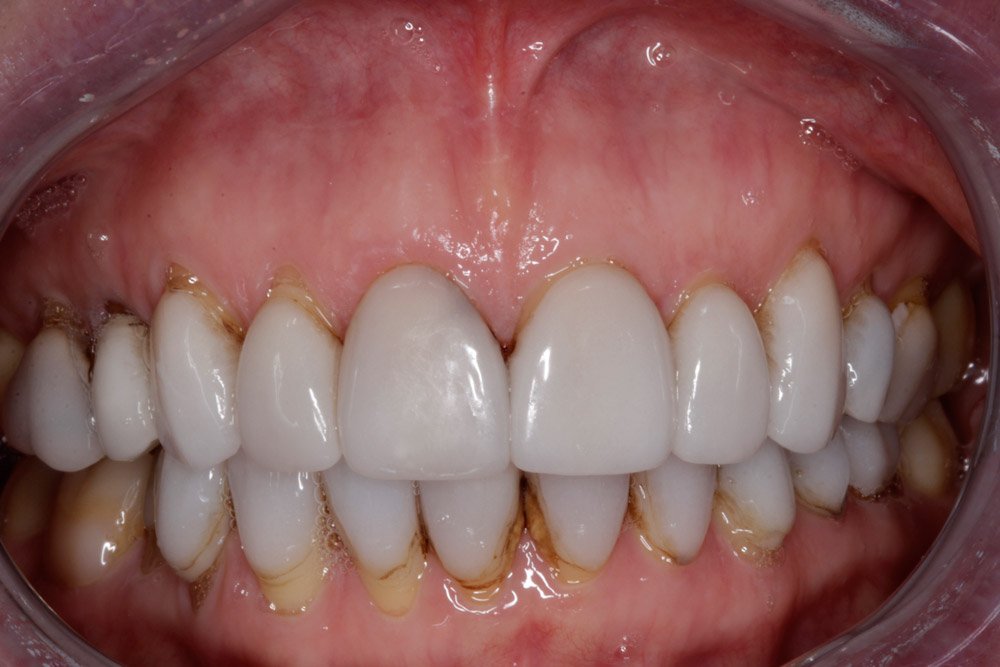
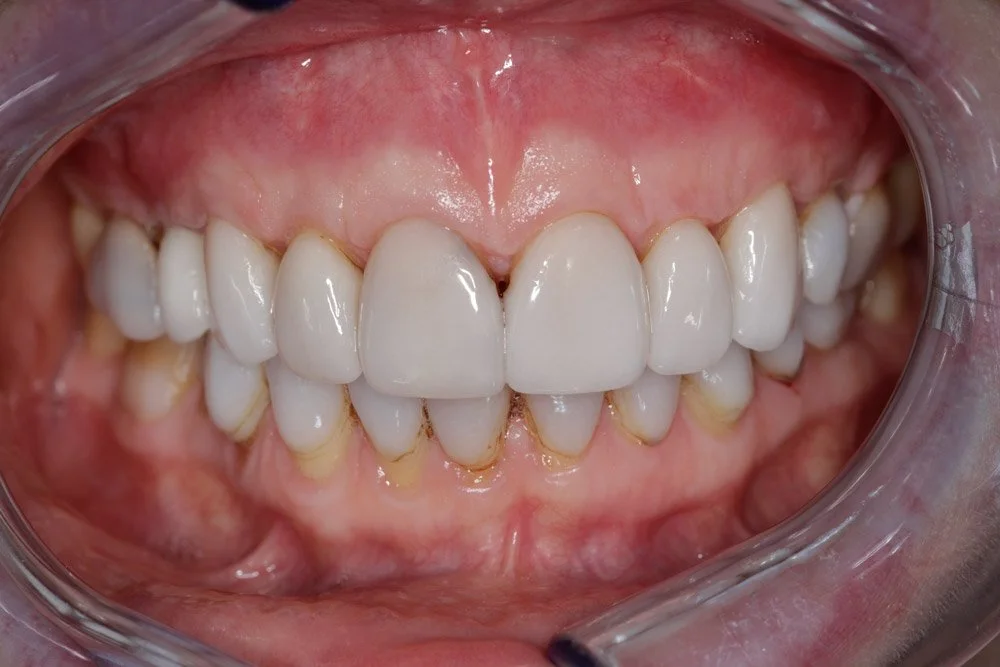
The above images show a before and after of soft tissue grafting around exposed veneers. Soft tissue grafting can help cover exposed roots and improve the appearance of veneers affected by gum recession. By restoring healthy gum tissue around the teeth, this procedure can often enhance aesthetics and help preserve existing veneers without the need for replacement.
Protecting the Result Long-Term
Once the graft has healed, the post-operative phase is really about maintenance. Periodontal maintenance visits — typically recommended every three months for patients with a history of recession — are essential for monitoring graft stability, assessing tissue health, and catching early signs of any recurrence.
Long-term stability also requires addressing the original cause of recession: correcting brushing technique, managing inflammation, and in some cases, addressing bite-related forces or orthodontic factors. The goal of grafting is not only to improve the before picture — it is to prevent sliding back toward it.
How much does a gum graft cost in NYC? +
Gum graft cost in New York City typically ranges from $600 to $3,000 per tooth, with most Manhattan cases falling between $900 and $1,800. The final cost depends on the type of graft, number of teeth treated, complexity of the case, and the specialist's experience. Dental insurance may cover a portion when the procedure is deemed medically necessary.
What are the different types of gum grafts? +
The four main types are: connective tissue grafts (the most common), free gingival grafts (best for increasing tissue width), pedicle grafts (used when adjacent tissue is sufficient), and allografts (donor tissue from a tissue bank). The Chao Pinhole® Technique is a minimally invasive alternative for selected cases.
What will my gums look like right after the procedure? +
The immediate post-operative result does not reflect the final outcome. The grafted tissue will often look fuller, redder, and more swollen than expected. This is normal. The area needs 1–2 weeks for initial healing and several additional weeks for full tissue integration and contour settling.
Is dental insurance likely to cover gum grafting? +
Many dental insurance plans cover a portion of gum grafting when it is deemed medically necessary — particularly when recession is associated with documented periodontal disease. Coverage varies significantly by plan. Request a pre-treatment estimate from your carrier before scheduling treatment.
Does every gum graft require tissue from the roof of my mouth? +
No. Allografts, platelet-rich fibrin protocols, and the Chao Pinhole® Technique can all be used in appropriate cases without harvesting palatal tissue. The right approach depends on tissue thickness, extent of recession, aesthetic goals, and your overall oral health. A consultation with a board-certified periodontist will clarify which option suits your specific anatomy.
